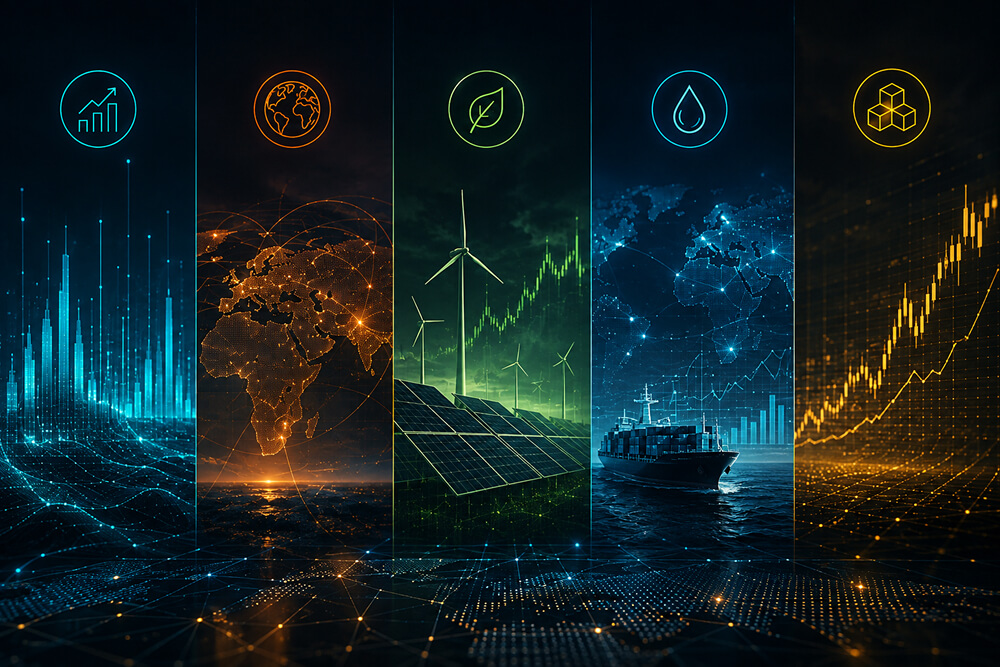
Energy and commodity markets are entering a period in which the most consequential risks and opportunities are increasingly emerging between traditional market categories.
Geopolitics is reshaping physical flows. Regulation is influencing liquidity. Energy security is changing investment priorities. Infrastructure constraints are affecting commodity economics. AI is beginning to alter how trading organisations process information and make decisions.
None of these forces exists in isolation.
The more important signal is their convergence.
For leadership teams, the question is no longer simply where prices move next.
It is whether the organisation can understand the forces behind those movements early enough to respond intelligently.
“The next competitive advantage in commodity markets will not come from having more information. It will come from understanding the relationship between market structure, geopolitical risk, capital and operational exposure before those connections are fully reflected in price.”
– Doug Gyani, CEO, Principia Consulting
Here are five signals we believe matter now.
01. VOLATILITY IS BECOMING STRUCTURAL
Commodity businesses have always operated with volatility.
What is changing is its source.
Price formation is increasingly influenced by forces outside traditional supply-and-demand models: geopolitical intervention, sanctions, transportation constraints, regulatory change, financing conditions and national energy-security priorities.
A disruption that begins thousands of kilometres away can rapidly become a freight issue, a liquidity constraint, a counterparty concern and ultimately a P&L event.
That requires leadership teams to think differently about risk.
Risk can no longer sit purely downstream as a control mechanism. Increasingly, it needs to inform commercial strategy itself.
THE SIGNAL: Risk intelligence is becoming commercial intelligence.
THE QUESTION: If conditions changed materially tomorrow, could leadership see the organisation’s true exposure quickly enough to act?
02. ENERGY SECURITY IS ACQUIRING A PRICE
For much of the last decade, the energy conversation centred on transition.
The commercial conversation is increasingly about resilience during transition.
Supply diversification, storage, alternative transport corridors, redundant infrastructure and flexible contracting can all appear inefficient when markets are stable.
Their economic value becomes very different when they are not.
This means the traditional optimisation model is changing.
The cheapest supply chain may not necessarily be the most commercially valuable if it contains concentrated geopolitical, infrastructure or counterparty risk.
Optionality is becoming an asset.
“Resilience is becoming a commercial capability. It is no longer enough to optimise an organisation for efficiency under normal conditions; leaders need operating models capable of performing when the assumptions underneath the market change.”
– Pyxis Advisory
THE SIGNAL: Energy security is moving from government policy into enterprise economics.
THE QUESTION: Where does your operating model contain a single point of failure that is not currently priced into the commercial decision?
03. CAPITAL IS REVEALING THE NEXT MARKET
Headlines tell us what markets are discussing.
Capital allocation can tell us what sophisticated investors expect to matter next.
Investment continues to move across LNG, gas infrastructure, grids, storage, renewables, conventional supply and new energy technologies.
The important insight is not that one energy source is replacing another.
It is that the future energy system is increasingly being constructed as a portfolio of capabilities.
- Security.
- Flexibility.
- Scalability.
- Transmission.
- Storage.
- Generation.
- Physical infrastructure.
The binary language surrounding energy transition often fails to capture what investment behaviour is actually telling us.
Markets are building redundancy and optionality because the future is unlikely to follow a single linear scenario.
THE SIGNAL: Follow infrastructure investment as closely as commodity prices.
THE QUESTION: Is your strategy built around the prevailing market narrative or around the physical system the market will actually require?
04. THE NEXT ENERGY BOTTLENECK MAY NOT BE ENERGY
The future energy system must be physically built.
That makes metals, minerals, transmission infrastructure, logistics and processing capacity integral to the energy equation.
Electrification requires copper.
Grid expansion requires metals.
Data centres require power, cooling and transmission.
Battery systems require complex mineral supply chains.
LNG growth requires terminals, vessels and associated infrastructure.
This creates an important second-order market dynamic.
Demand growth in one sector can create scarcity somewhere entirely different in the value chain.
The constraint on energy expansion may therefore not be energy production itself.
It may be the infrastructure or commodity required to deliver it.
THE SIGNAL: Second-order demand may matter as much as primary demand.
THE QUESTION: Which physical input does your future strategy depend upon that every competitor may also need at the same time?
05. AI WILL SHIFT THE ADVANTAGE FROM DATA TO DECISION INTELLIGENCE
Commodity organisations do not lack information.
Many lack integration.
Market data sits in one environment.
CTRM in another.
ERP somewhere else.
Risk, finance, logistics and operational information can all operate with different versions of the same commercial reality.
AI introduces enormous potential, but it also exposes a fundamental weakness.
Artificial intelligence cannot compensate for poor information architecture indefinitely.
If underlying data, processes and ownership remain fragmented, organisations risk automating complexity rather than removing it.
The opportunity is considerably bigger than automation.
It is the creation of decision intelligence: connecting information across the enterprise so that the right insight reaches the right person at the point at which a commercial decision needs to be made.
That distinction will become increasingly important.
The winners in AI adoption may not be the organisations deploying the most technology.
They may be the organisations with the strongest underlying architecture for turning information into action.
THE SIGNAL: Data volume is losing value. Decision quality is gaining it.
THE QUESTION: Which decisions inside your organisation would create the greatest commercial advantage if they could be made earlier and with greater confidence?
THE SIGNAL BEHIND THE SIGNALS
The five developments above share a common thread.
Market complexity is increasingly becoming organisational complexity.
A geopolitical event becomes a logistics issue.
Logistics affects liquidity.
Liquidity changes risk.
Regulation redirects capital.
Infrastructure alters commodity demand.
Technology determines how quickly leadership can see all of it.
That is why the next competitive advantage will not simply be market foresight.
It will be operating capability.
The organisations best positioned for the next cycle will be those capable of connecting market intelligence with systems, risk, capital and operational decision-making before disruption forces the issue.
FIVE QUESTIONS FOR THE LEADERSHIP TABLE
- Where is geopolitical risk beginning to change our commercial assumptions?
- Where have we mistaken efficiency for resilience?
- What are capital flows telling us that prices may not yet reflect?
- Which infrastructure or commodity constraint could affect our strategy next?
- Can our systems connect market, trading, risk and financial information quickly enough to support a decision when it matters?
The objective is not to predict every market movement.
It is to build an organisation capable of recognising change early enough to respond intelligently.
SEE THE SIGNAL. UNDERSTAND THE IMPACT. ACT EARLIER.
Principia × Pyxis bring together expertise across energy, commodities, trading, technology and transformation to help leadership teams navigate increasingly interconnected markets.
If your organisation is reviewing its trading environment, technology strategy, operating model or readiness for the next market cycle, start a conversation with the advisory team.
CONNECT WITH PRINCIPIA × PYXIS
From market intelligence to commercial action.