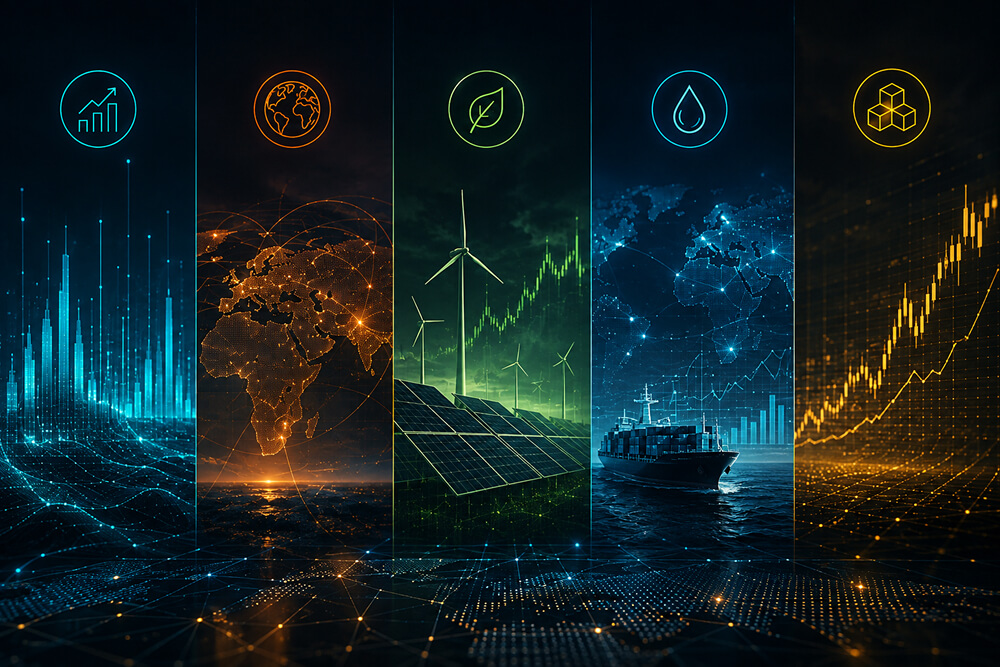
Energy markets are becoming increasingly interconnected, while the forces influencing liquidity are becoming more fragmented.
Sanctions, shifting trade corridors, regulatory intervention, financing constraints and heightened energy-security concerns are changing not only where commodities move, but how market participants assess exposure and opportunity.
For trading organisations, this creates a fundamentally different operating environment.
Traditional analysis of price, supply and physical demand remains essential. But on its own, it is no longer enough.
Political risk can redirect trade. Regulation can alter the economics of a transaction. Infrastructure constraints can determine whether supply is commercially accessible. Financing conditions can influence liquidity. Technology can change the speed at which information moves through the market.
Increasingly, these forces are converging.
“The market signal is rarely contained in one dataset. Competitive advantage increasingly comes from understanding how geopolitics, regulation, liquidity and physical markets interact before their combined impact becomes obvious.”
– Principia × Pyxis
LIQUIDITY IS BECOMING MORE STRATEGIC
Liquidity has traditionally been viewed primarily through the lens of market depth, available counterparties and access to capital.
That definition is becoming more complex.
Liquidity today can also be influenced by sanctions exposure, banking appetite, regulatory requirements, credit conditions, collateral demands and an organisation’s ability to move quickly between counterparties and markets.
A commodity may remain physically available while becoming more difficult, expensive or commercially complex to transact.
That distinction matters.
For trading organisations, understanding where liquidity exists is increasingly about understanding the entire ecosystem surrounding a transaction, not simply the availability of the underlying commodity.
When regulation, financing and geopolitical risk begin to converge, liquidity itself can migrate.
The ability to recognise those movements early can materially influence trading strategy, risk management and capital allocation.
GEOPOLITICS IS NOW AN OPERATING VARIABLE
Geopolitics is no longer something energy companies can treat purely as macroeconomic context.
It increasingly affects day-to-day commercial decisions.
Sanctions can change eligible counterparties. Conflict can alter shipping routes and insurance costs. Government intervention can affect exports. Strategic competition between nations can reshape supply chains and investment priorities.
Energy security has also returned to the centre of government policy.
For many markets, the conversation has moved beyond securing the lowest-cost source of energy toward balancing affordability, reliability, resilience and national strategic interests.
Those priorities do not always move in the same direction.
As governments attempt to reconcile them, trading organisations may face new regulations, incentives, restrictions and market structures.
This creates both risk and opportunity.
The important question is whether organisations have the intelligence and operating capability to distinguish between the two.
REGULATION IS MOVING CLOSER TO THE TRADING DESK
Regulation is becoming more deeply embedded in commercial strategy.
Environmental requirements, reporting obligations, sanctions regimes, financial-market rules and evolving energy policies can all influence the economics and viability of transactions.
For leaders, compliance can therefore no longer be considered an isolated function operating downstream from the commercial decision.
Its implications need to be understood much earlier.
A regulatory development in one jurisdiction can affect pricing, counterparties, documentation, logistics and market access across several others.
Organisations capable of incorporating regulatory intelligence into trading and strategic decision-making will be better positioned to understand those implications before they become operational constraints.
CAPITAL IS CHANGING THE COMMERCIAL EQUATION
Capital availability represents another increasingly important signal.
Higher financing costs, changing lender appetite, counterparty credit concerns and greater scrutiny of energy investments can influence which transactions, assets and strategies remain commercially attractive.
For commodity businesses, this has direct implications.
Working-capital requirements can increase rapidly during periods of volatility. Margin requirements can place pressure on liquidity. Infrastructure projects may need to compete for capital against other strategic priorities.
At the same time, significant investment is required across energy infrastructure, technology, supply chains and transition-related assets.
The question is therefore not simply where capital is available.
It is where capital is willing to move, under what conditions and at what price.
That information can provide an early indicator of where markets themselves may be heading.
“The organisations that see these forces as interconnected rather than separate will have a materially clearer view of risk, liquidity and opportunity.”
– Principia × Pyxis
THE SIGNAL MAY APPEAR OUTSIDE THE MARKET FIRST
One of the most important changes for energy and commodity leaders is recognising that the next meaningful market movement may not originate in traditional market data.
It may appear first in:
- a policy announcement;
- a change in sanctions;
- a shift in shipping economics;
- an infrastructure bottleneck;
- a financing decision;
- a regulatory consultation;
- a technology investment;
- or a strategic decision made by a government thousands of kilometres away.
Individually, these events may appear peripheral.
Together, they can change the economics of an entire market.
This is why the ability to connect intelligence across disciplines is becoming increasingly valuable.
FROM INFORMATION TO DECISION INTELLIGENCE
Most organisations do not suffer from a shortage of information.
The difficulty is determining which information matters.
Executives, traders and risk teams operate in an environment of continuous data, research, news and commentary. The sheer volume can make it harder, rather than easier, to identify the developments with genuine commercial significance.
The competitive capability is therefore shifting from access to information toward interpretation.
- What changed?
- Why did it change?
- Which markets, counterparties or assets could be affected?
- What is the second-order impact?
- What should we be watching next?
- And, most importantly:
- Does this require us to act?
Answering those questions consistently requires more than market monitoring. It requires the integration of commercial, geopolitical, regulatory, operational and technological intelligence.
WHAT SHOULD LEADERS BE WATCHING?
For executive teams navigating the next phase of the market, several questions deserve continual attention:
Where could liquidity tighten or migrate?
Changes in banking appetite, regulation or geopolitical exposure can alter market liquidity faster than many traditional indicators reveal.
Which trade routes are becoming strategically vulnerable?
Infrastructure, conflict and policy can change the economics of physical flows rapidly.
Where is regulation changing commercial behaviour?
The most important regulatory developments are often those that alter incentives before they become obvious market events.
Where is capital moving?
Investment decisions can provide an early indication of which technologies, assets and markets are gaining strategic importance.
Where are our own blind spots?
Fragmented information inside the organisation can be just as dangerous as incomplete intelligence outside it.
SEEING THE CONNECTION IS THE ADVANTAGE
The next major movement in an energy or commodity market is unlikely to have a single cause.
- It may begin with policy.
- Be accelerated by geopolitics.
- Become constrained by infrastructure.
- Be amplified by liquidity.
- And ultimately appear as price.
- By the time all of those forces are visible in the market, the most important strategic decisions may already have been made.
- The opportunity for leadership teams is to develop a wider field of vision.
- To identify the connections earlier.
- To distinguish noise from signals.
And to convert those signals into decisions before the market makes their significance obvious.
“In complex markets, foresight is not about predicting the future with certainty. It is about recognising the forces that are converging early enough to make a better decision.”
– Principia × Pyxis
TURN MARKET SIGNALS INTO STRATEGIC ACTION
Principia × Pyxis bring together deep experience across energy and commodity trading, technology, transformation and strategic advisory to help organisations navigate increasingly interconnected markets.
Whether your organisation is assessing trading operations, technology, transformation, risk or its response to a changing market environment, the conversation starts with understanding where the pressure points and opportunities are emerging.
Connect with the advisory team to discuss what these shifts could mean for your organisation.